Inside the app
See Kyokushin in Martial Arts Toolkit
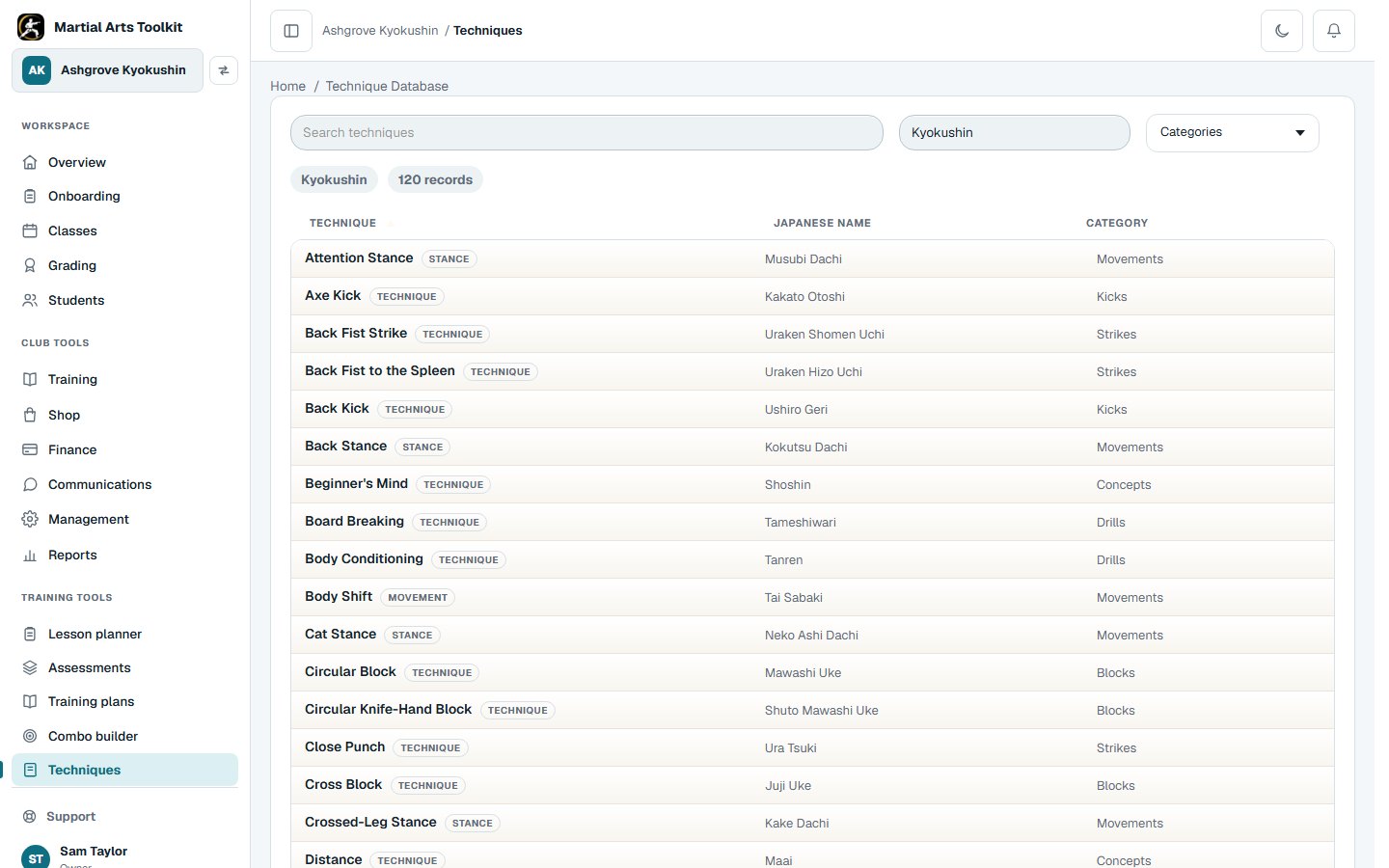
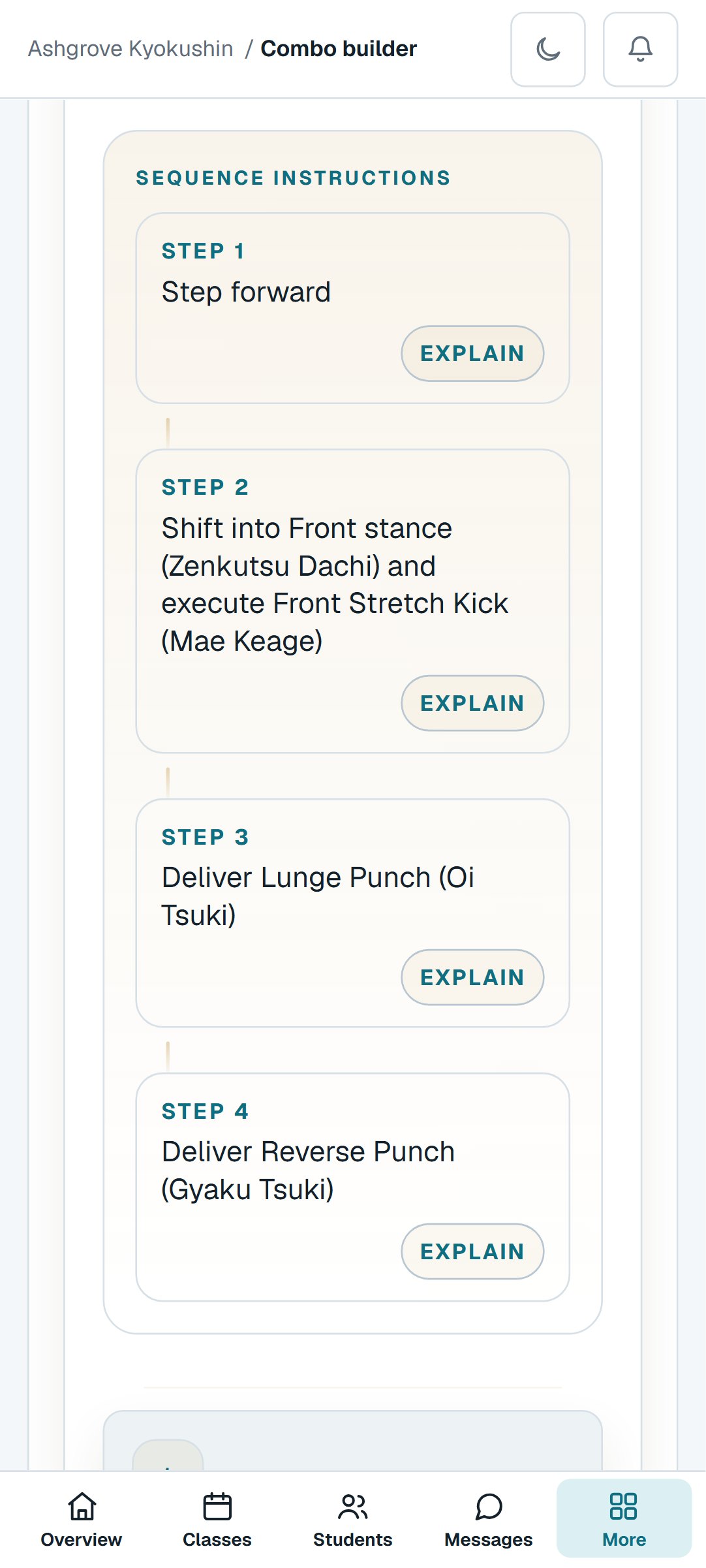
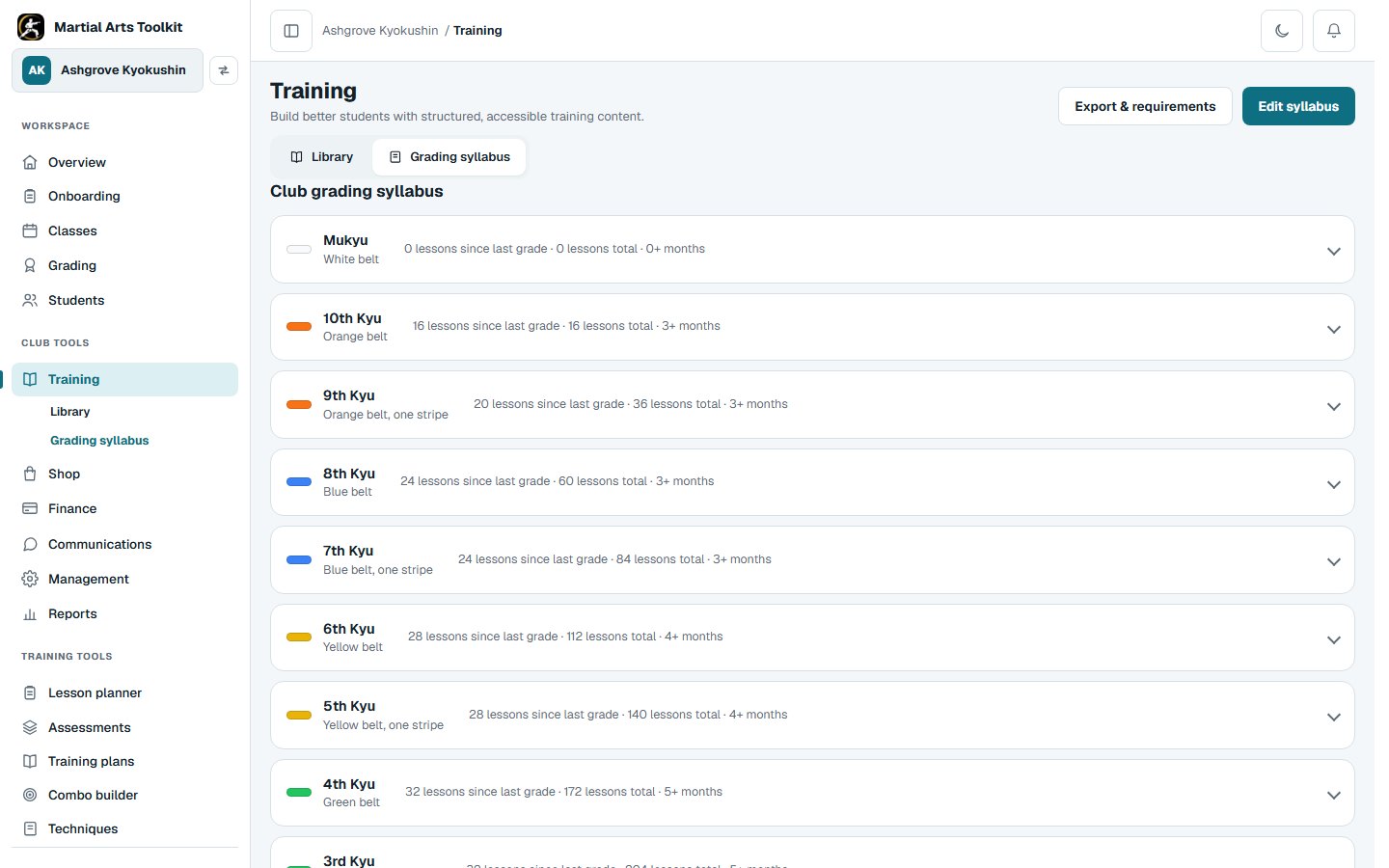
Real screens from Ashgrove Kyokushin, an example Kyokushin dojo: its technique library and grading syllabus on a computer, and the Combo Builder on a phone.
Screenshots use example data.
About the art
What is Kyokushin?
Kyokushin is the full-contact karate founded by Mas Oyama in Tokyo in 1964. Its name means 'the ultimate truth', and its training is famously hard: basics repeated to exhaustion, body conditioning, and knockdown fighting with full-power punches to the body and kicks to the legs, body and head.
Students learn kata from Taikyoku and Pinan to Sanchin, Tensho and Kanku, and grade through orange, blue, yellow, green and brown belts to black. The main organisations include the IKO Kyokushinkaikan and Shinkyokushinkai, with dojos across the UK.
- Origin
- Japan (founded 1964)
- Known for
- Full-contact knockdown fighting
- Technique names
- Japanese and English names
- Grades
- Mukyu to 1st Dan
How we work with Kyokushin
Built for the way Kyokushin is taught
The Kyokushin technique library and a starter grading ladder are ready when you create your dojo, and you can change any of it to match your syllabus.
Kihon, kata and kumite
Punches, kicks and blocks from seiken tsuki to ushiro mawashi geri, the kata from Taikyoku to Kanku, and the drills and ideas behind them, from sanbon kumite to osu no seishin.
Knockdown combinations
The Combo Builder links body punches, low kicks and shin blocks the way knockdown fighting does: a reverse punch into a low kick, or a shin block answered with a punch.
Belts in Kyokushin colours
Start from a kyu ladder in the Kyokushin order - orange, blue, yellow, green and brown - to shodan, and set the time each grade needs.
From the Kyokushin library
- Reverse Punch (Gyaku Tsuki)
- Low Roundhouse Kick (Gedan Mawashi Geri)
- Shin Block (Sune Uke)
- Upward Body Punch (Shita Tsuki)
- Spinning Hook Kick (Ushiro Mawashi Geri)
- Circular Block (Mawashi Uke)
Kata ready to use
- Taikyoku Sono Ichi
- Taikyoku Sono Ni
- Taikyoku Sono San
- Sokugi Taikyoku Sono Ichi
- Sokugi Taikyoku Sono Ni
- Sokugi Taikyoku Sono San
- Pinan Sono Ichi
- Pinan Sono Ni
And 15 more, plus any you add yourself.
Running the dojo
Everything else your dojo needs
Registers, gradings, payments and the student portal all use the same student record, so nothing has to be copied between spreadsheets.
Registers and attendance
Take the register on a phone or tablet in seconds and spot students who have stopped coming.
Grading readiness
Attendance, time in grade and assessments come together, so you can see who is ready for the next grading.
Memberships and payments
Set up memberships and take payments through Stripe, with a clear view of who has paid.
Classes and timetable
Recurring classes and one-off sessions in one timetable, with RSVP and check-in links for families.
Student and parent portal
Students and parents see grades, upcoming classes, assigned training and what to work on next.
Lesson plans and training plans
Plan classes from the technique library, assess students and give each one training to practise at home.
Try it with your own dojo
Less time on administration.
More time to teach Kyokushin.
Create your dojo free and explore it with your own classes, or book a demo and we will show you around.
Questions
Kyokushin dojos often ask
We are a Kyokushin dojo. Why not just choose Karate?
Kyokushin has its own kata, its own belt colours and its own way of fighting. Choosing Kyokushin gives your students the right syllabus from the start, and you can add Karate too if your dojo teaches both.
Can we include body conditioning and tameshiwari in gradings?
Yes. Both are in the library, so they can go into a syllabus, an assessment or a lesson plan like any technique.
Can we use our own syllabus and grades?
Yes. The starter ladder is only a starting point. Rename grades, change colours, add your own requirements and set the lessons and time each grade needs.
Can one club teach more than one martial art?
Yes. Choose a main martial art when you create your club and add others in the club settings. Each keeps its own technique library.
Can you move our students across from our current system?
Yes. Import students from a spreadsheet and check every row before it is saved, or send us your records and we will move them across for you free of charge.
How much does it cost?
Small clubs can use the Free plan with no card required. Paid plans add capacity and features as your club grows.