Inside the app
See Karate in Martial Arts Toolkit
Real screens from Riverside Karate Club, an example Karate club: its technique library and grading syllabus on a computer, and the Combo Builder on a phone.
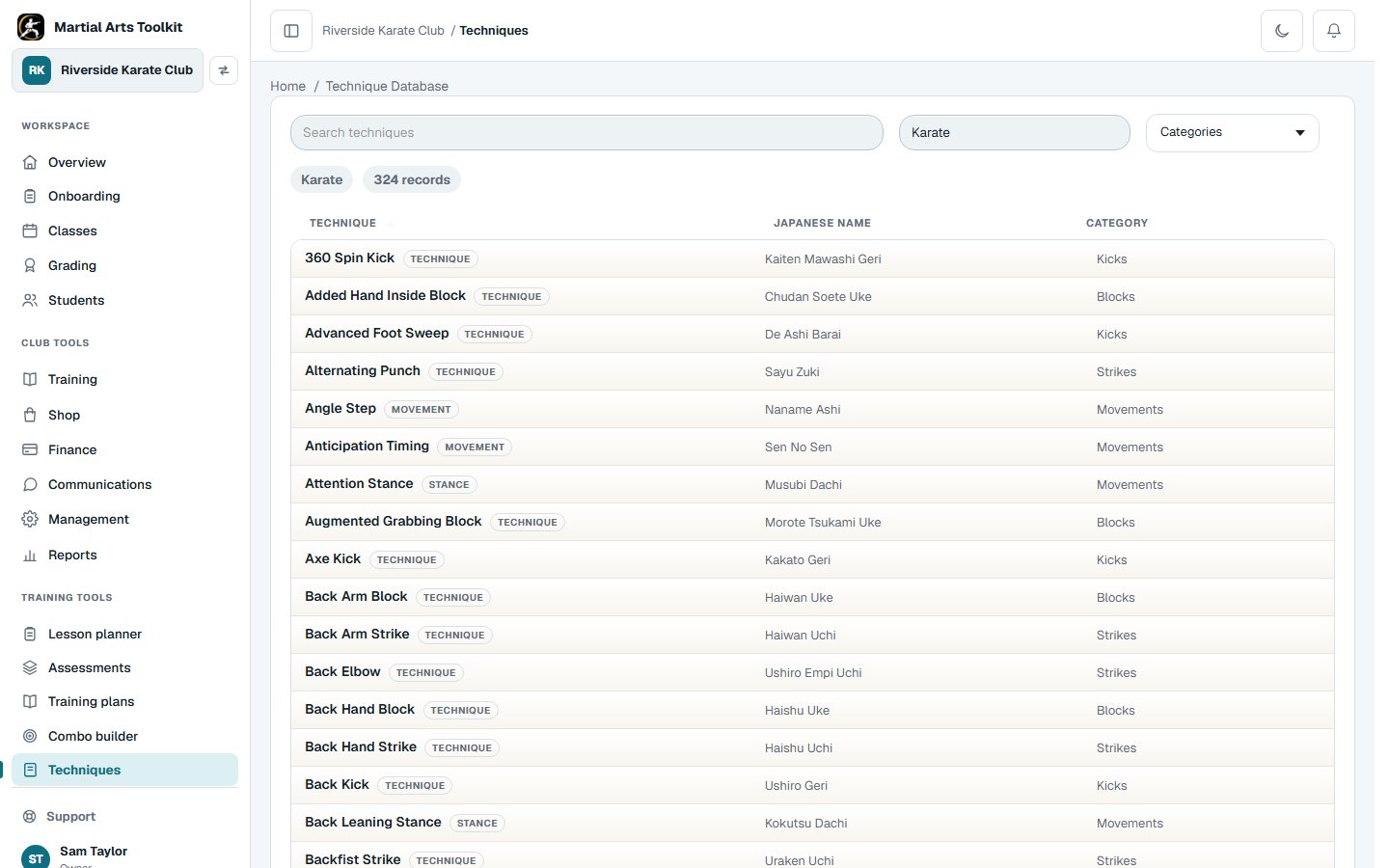
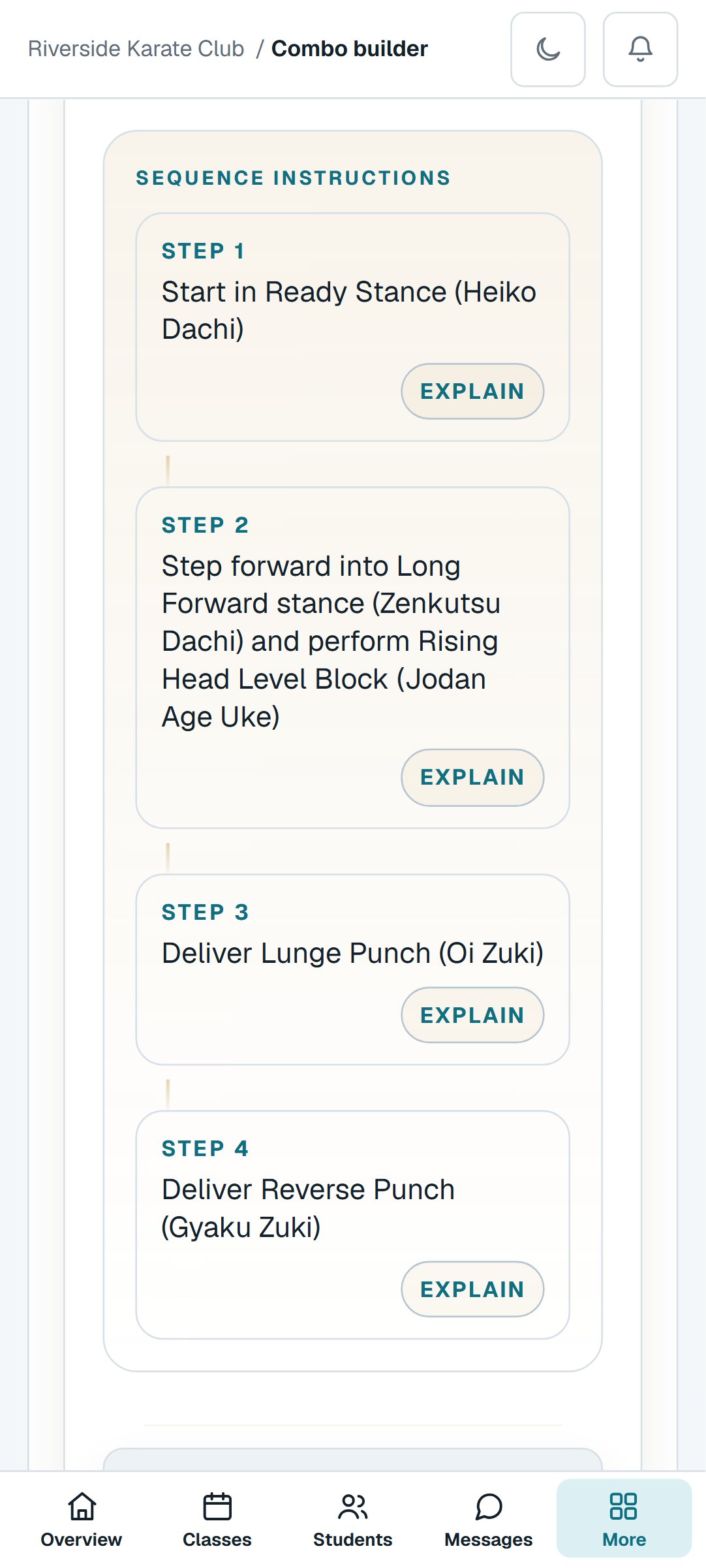
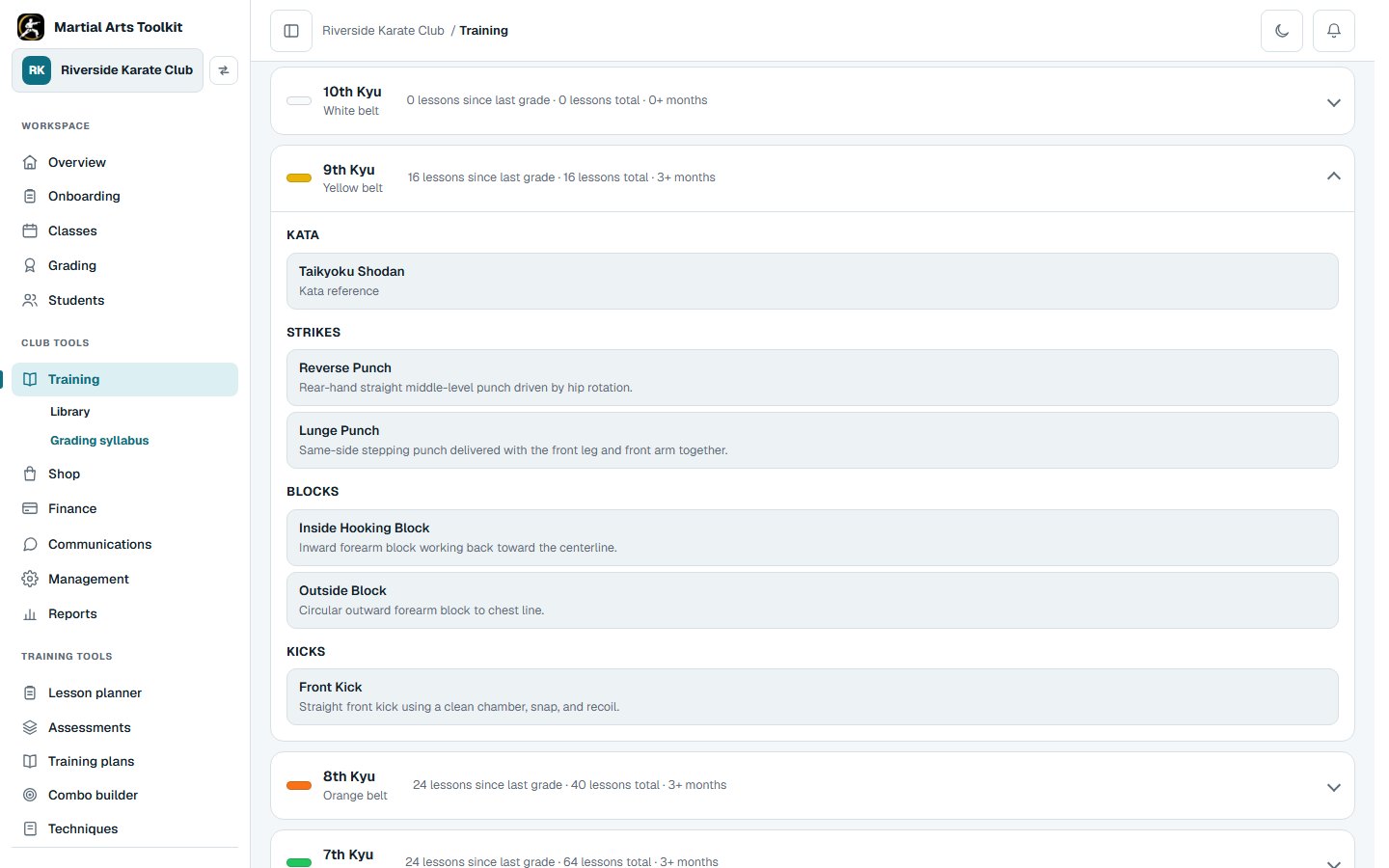
Screenshots use example data.
About the art
What is Karate?
Karate grew up in Okinawa from local fighting methods and Chinese influences, and spread through mainland Japan in the early twentieth century. The name means "empty hand". Training is usually divided into kihon (basics), kata (forms) and kumite (sparring), and students progress through kyu grades, marked by coloured belts, towards black belt dan grades.
Clubs follow many styles, including Shotokan, Goju-Ryu, Wado-Ryu and Shito-Ryu, and each has its own kata and syllabus. Most clubs grade several times a year, so tracking attendance, time in grade and syllabus requirements is a large part of an instructor's week.
- Origin
- Okinawa, Japan
- Known for
- Kihon, kata and kumite
- Technique names
- Japanese and English names
- Grades
- 10th Kyu to 4th Dan
How we work with Karate
Built for the way Karate is taught
The Karate technique library and a starter grading ladder are ready when you create your club, and you can change any of it to match your syllabus.
Kata for your style
The kata list runs from the Taikyoku kata to Unsu and includes the Heian, Tekki and Goju-Ryu kata such as Gekisai, Saifa and Seiyunchin. Link each kata to the grade that needs it.
A syllabus ready to edit
Start from a kyu-to-dan syllabus that already lists kata, strikes, blocks and kicks for each grade, then rename grades, change belt colours and set your own requirements.
Kihon and combinations
The Combo Builder only joins techniques that naturally follow each other and lands each step in a sensible stance, so kihon lines and pad drills read the way you teach them.
From the Karate library
- Rising Head Level Block (Jodan Age Uke)
- Inside Hooking Block (Uchi Uke)
- Round Kick (Mawashi Geri)
- Side Kick (Yoko Geri)
- Outside Knife Hand Strike (Shuto Uchi)
- Back Kick (Ushiro Geri)
Kata ready to use
- Taikyoku Gedan
- Taikyoku Chudan
- Taikyoku Jodan
- Gekisai Dai Ichi
- Gekisai Dai Ni
- Saifa
- Seiyunchin
- Shisochin
And 32 more, plus any you add yourself.
Running the club
Everything else your club needs
Registers, gradings, payments and the student portal all use the same student record, so nothing has to be copied between spreadsheets.
Registers and attendance
Take the register on a phone or tablet in seconds and spot students who have stopped coming.
Grading readiness
Attendance, time in grade and assessments come together, so you can see who is ready for the next grading.
Memberships and payments
Set up memberships and take payments through Stripe, with a clear view of who has paid.
Classes and timetable
Recurring classes and one-off sessions in one timetable, with RSVP and check-in links for families and text messages for reminders and cancellations.
Student and parent portal
Students and parents see grades, upcoming classes, assigned training and what to work on next.
Lesson plans and training plans
Plan classes from the technique library, assess students and give each one training to practise at home.
Try it with your own club
Less time on administration.
More time to teach Karate.
Create your club free and explore it with your own classes, or book a demo and we will show you around.
Questions
Karate clubs often ask
Does it work for Shotokan, Goju-Ryu and Wado-Ryu clubs?
Yes. The technique library and kata list cover the common styles, and every club edits its own syllabus, so students see your association's requirements rather than a generic list.
Can students see Japanese names?
Yes. Choose Japanese and English, English only or Japanese only for the whole club, and technique names appear that way in lesson plans, assessments and the student portal.
Can we use our own syllabus and grades?
Yes. The starter ladder is only a starting point. Rename grades, change colours, add your own requirements and set the lessons and time each grade needs.
Can one club teach more than one martial art?
Yes. Choose a main martial art when you create your club and add others in the club settings. Each keeps its own technique library.
Can you move our students across from our current system?
Yes. Import students from a spreadsheet and check every row before it is saved, or send us your records and we will move them across for you free of charge.
How much does it cost?
Small clubs can use the Free plan with no card required. Paid plans add capacity and features as your club grows.