Inside the app
See Shorinji Kempo in Martial Arts Toolkit
Real screens from Northgate Shorinji Kempo, an example Shorinji Kempo branch: its technique library and grading syllabus on a computer, and the Combo Builder on a phone.
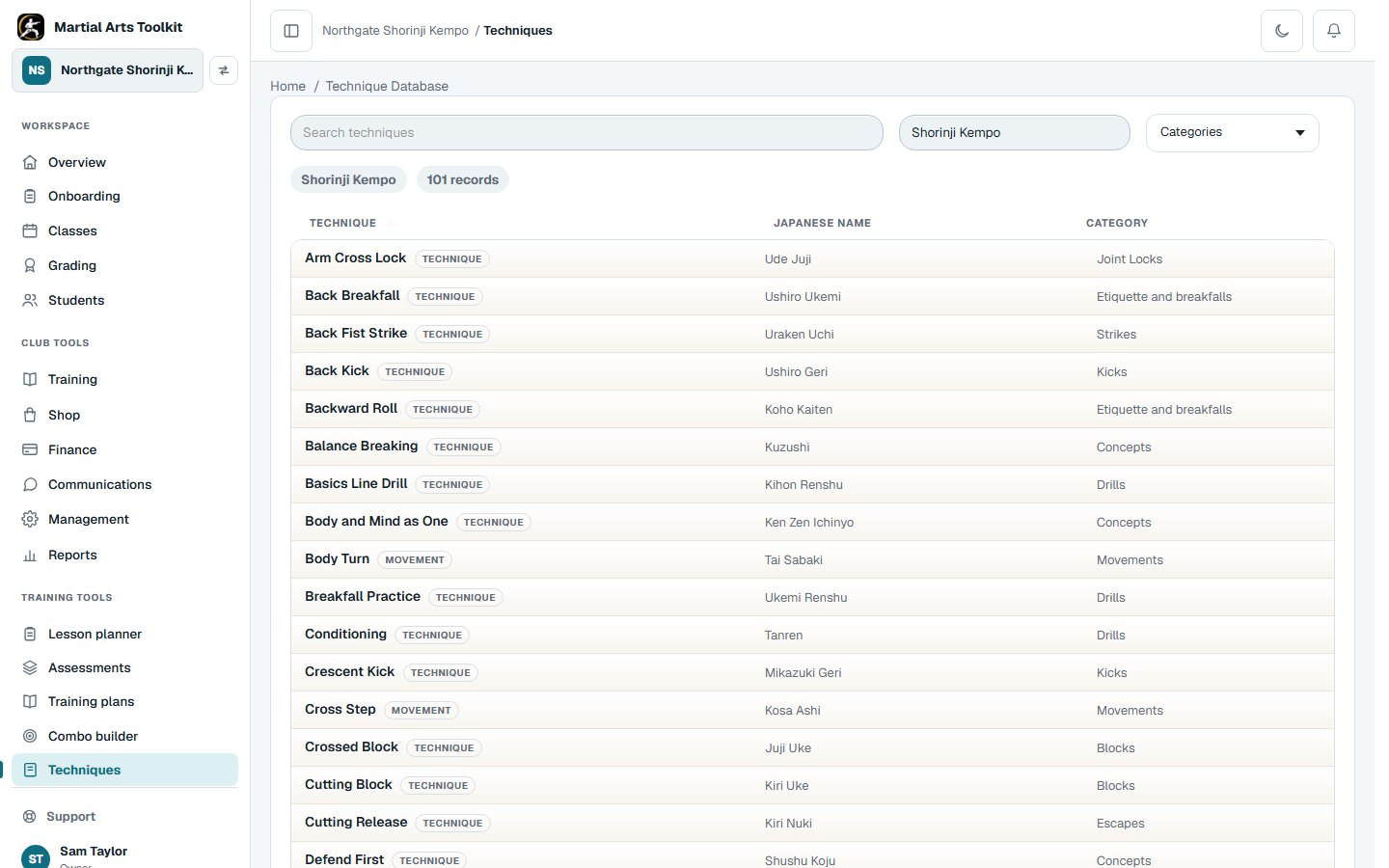
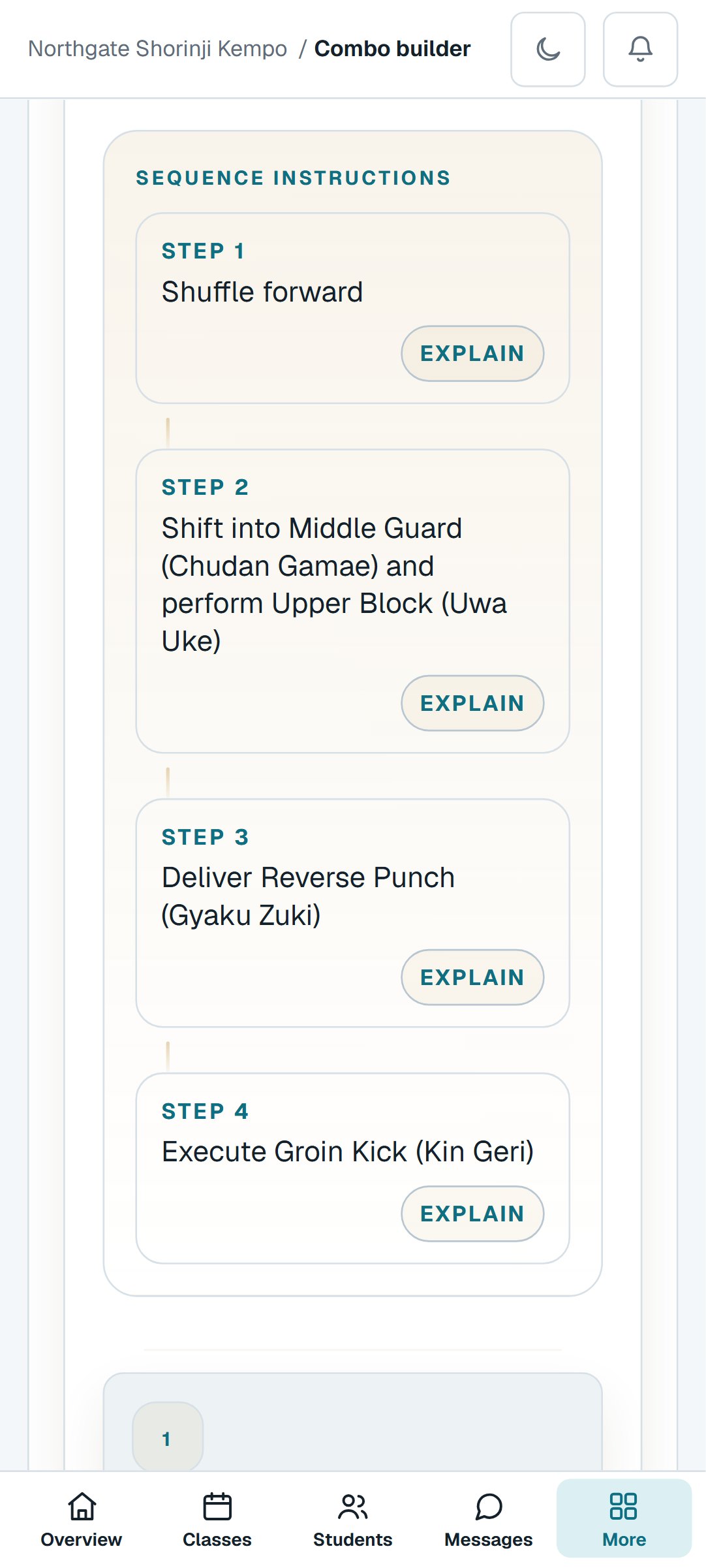
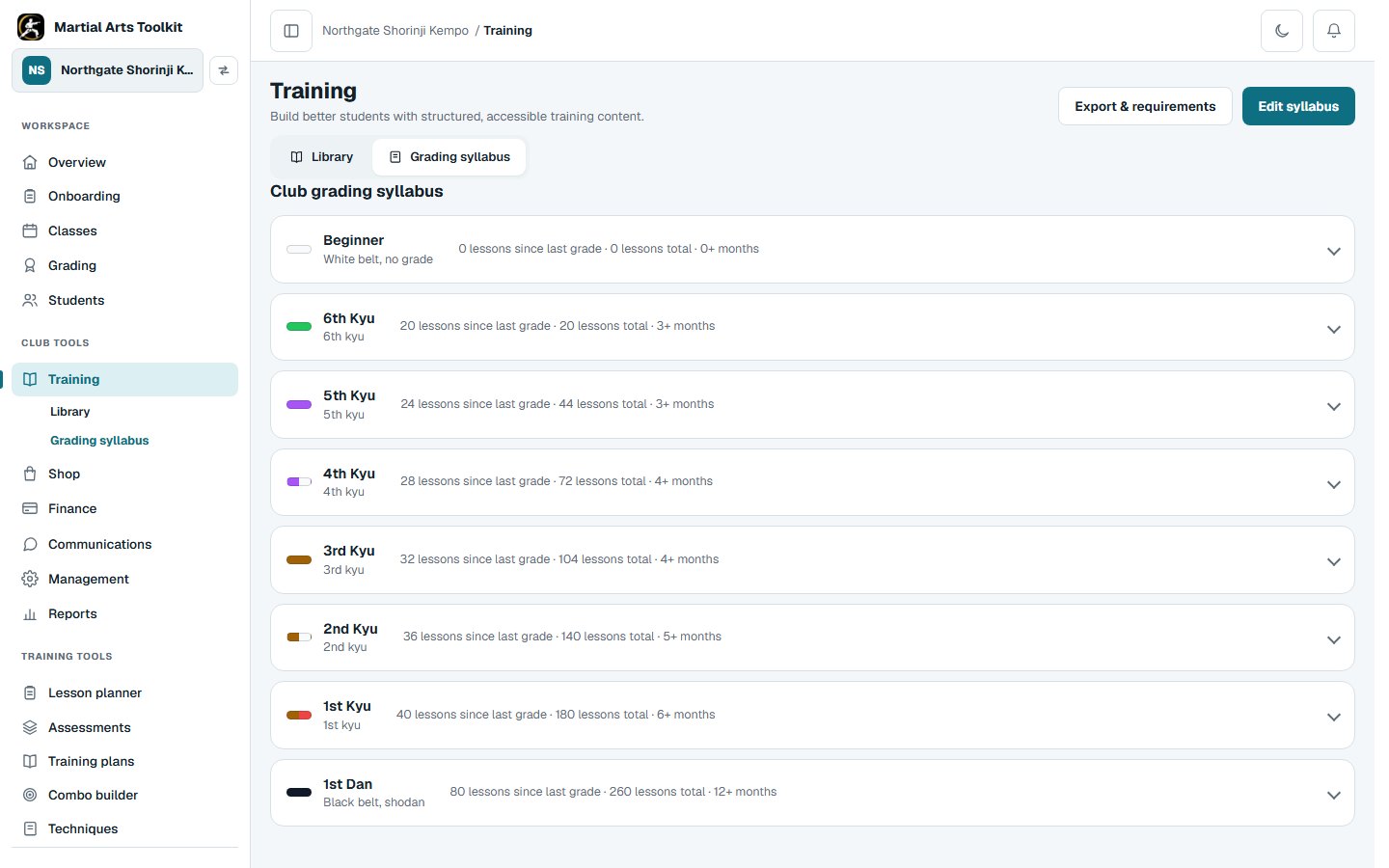
Screenshots use example data.
About the art
What is Shorinji Kempo?
Shorinji Kempo was founded in Japan in 1947 by Doshin So as a way of developing people as well as a means of self-defence. It combines goho, the hard techniques of punches, kicks and blocks, with juho, the soft techniques of releases, wrist locks and throws, always practised in pairs.
Defence comes first: every technique begins by receiving an attack. Kenshi grade through kyu grades to shodan and beyond in one worldwide organisation (WSKO), represented in the UK by the British Shorinji Kempo Federation.
- Origin
- Japan (founded 1947)
- Known for
- Hard and soft techniques together
- Technique names
- Japanese and English names
- Grades
- Beginner to 1st Dan
How we work with Shorinji Kempo
Built for the way Shorinji Kempo is taught
The Shorinji Kempo technique library and a starter grading ladder are ready when you create your branch, and you can change any of it to match your syllabus.
Goho and juho in one library
Punches, kicks, blocks and combined counters alongside releases, wrist locks, throws and pins, with the principles behind them such as shushu koju.
Defence-first combinations
The Combo Builder starts from a block or a release and builds the counter, the way paired practice does: an upper block and punch, or a wrist release into a reverse wrist throw.
Kyu gradings and embu
Start from a ladder of six kyu grades to shodan, with the Tenchiken hokei ready for syllabuses, lesson plans and embu practice.
From the Shorinji Kempo library
- Upper Block and Punch (Uwa Uke Zuki)
- Groin Kick (Kin Geri)
- Wrist Release (Kote Nuki)
- Reverse Wrist Throw (Gyaku Gote)
- Swallow Counter (Tsubame Gaeshi)
- Sending Wrist Lock (Okuri Gote)
Hokei ready to use
- Tenchiken Dai Ikkei
- Tenchiken Dai Nikei
- Tenchiken Dai Sankei
- Tenchiken Dai Yonkei
- Tenchiken Dai Gokei
- Tenchiken Dai Rokkei
Running the branch
Everything else your branch needs
Registers, gradings, payments and the student portal all use the same student record, so nothing has to be copied between spreadsheets.
Registers and attendance
Take the register on a phone or tablet in seconds and spot students who have stopped coming.
Grading readiness
Attendance, time in grade and assessments come together, so you can see who is ready for the next grading.
Memberships and payments
Set up memberships and take payments through Stripe, with a clear view of who has paid.
Classes and timetable
Recurring classes and one-off sessions in one timetable, with RSVP and check-in links for families.
Student and parent portal
Students and parents see grades, upcoming classes, assigned training and what to work on next.
Lesson plans and training plans
Plan classes from the technique library, assess students and give each one training to practise at home.
Try it with your own branch
Less time on administration.
More time to teach Shorinji Kempo.
Create your branch free and explore it with your own classes, or book a demo and we will show you around.
Questions
Shorinji Kempo branchs often ask
Can we record embu for gradings and taikai?
Yes. Add embu to a syllabus or an assessment, record each pair's progress and plan embu practice in your lesson plans.
Can kenshi see the Japanese names?
Yes. Every technique has its Japanese name alongside the English, and you can show Japanese only, English only or both for the whole branch.
Can we use our own syllabus and grades?
Yes. The starter ladder is only a starting point. Rename grades, change colours, add your own requirements and set the lessons and time each grade needs.
Can one club teach more than one martial art?
Yes. Choose a main martial art when you create your club and add others in the club settings. Each keeps its own technique library.
Can you move our students across from our current system?
Yes. Import students from a spreadsheet and check every row before it is saved, or send us your records and we will move them across for you free of charge.
How much does it cost?
Small clubs can use the Free plan with no card required. Paid plans add capacity and features as your club grows.