Inside the app
See Ninjutsu in Martial Arts Toolkit
Real screens from Greywood Ninjutsu Dojo, an example Ninjutsu dojo: its technique library and grading syllabus on a computer, and the Combo Builder on a phone.
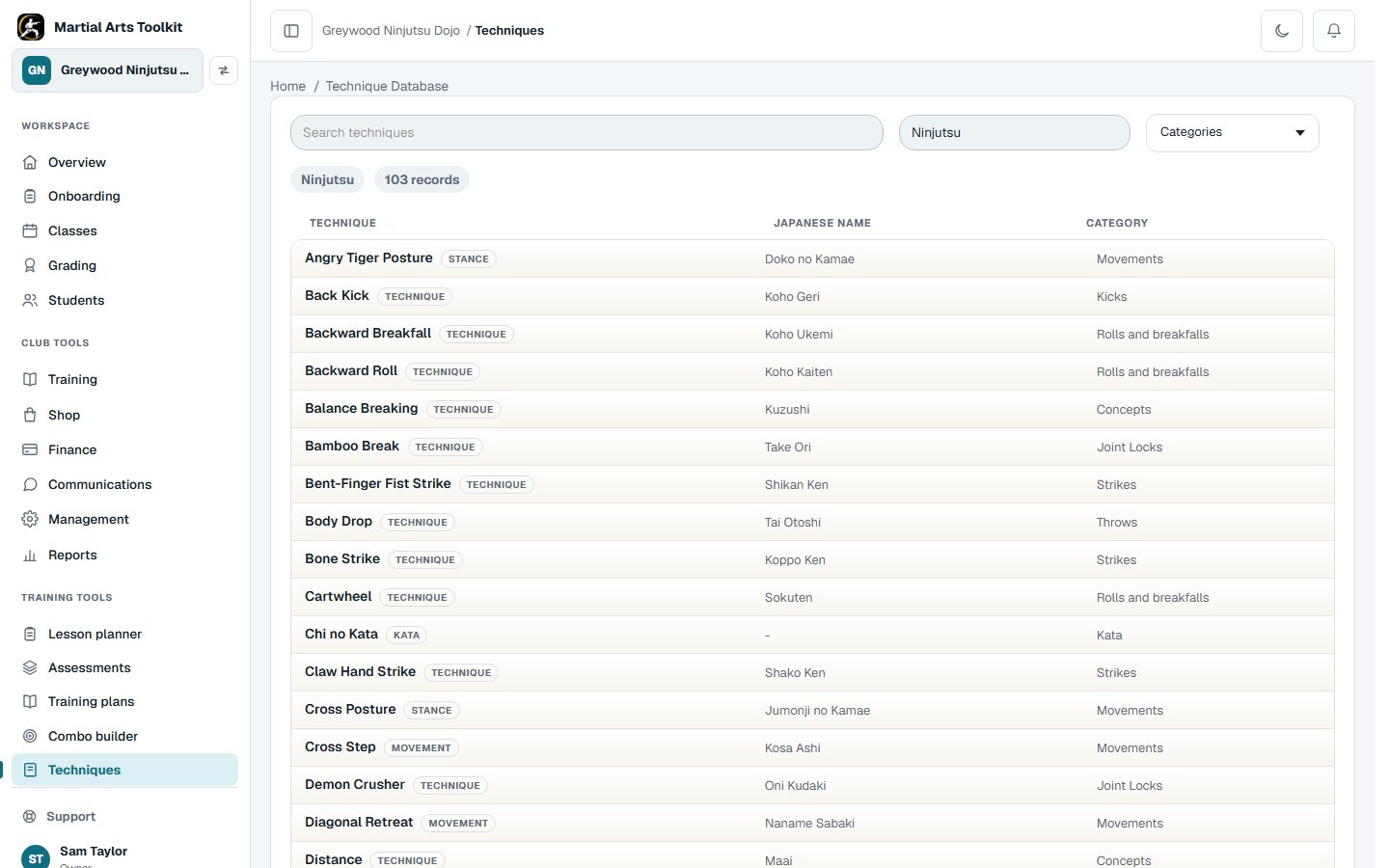
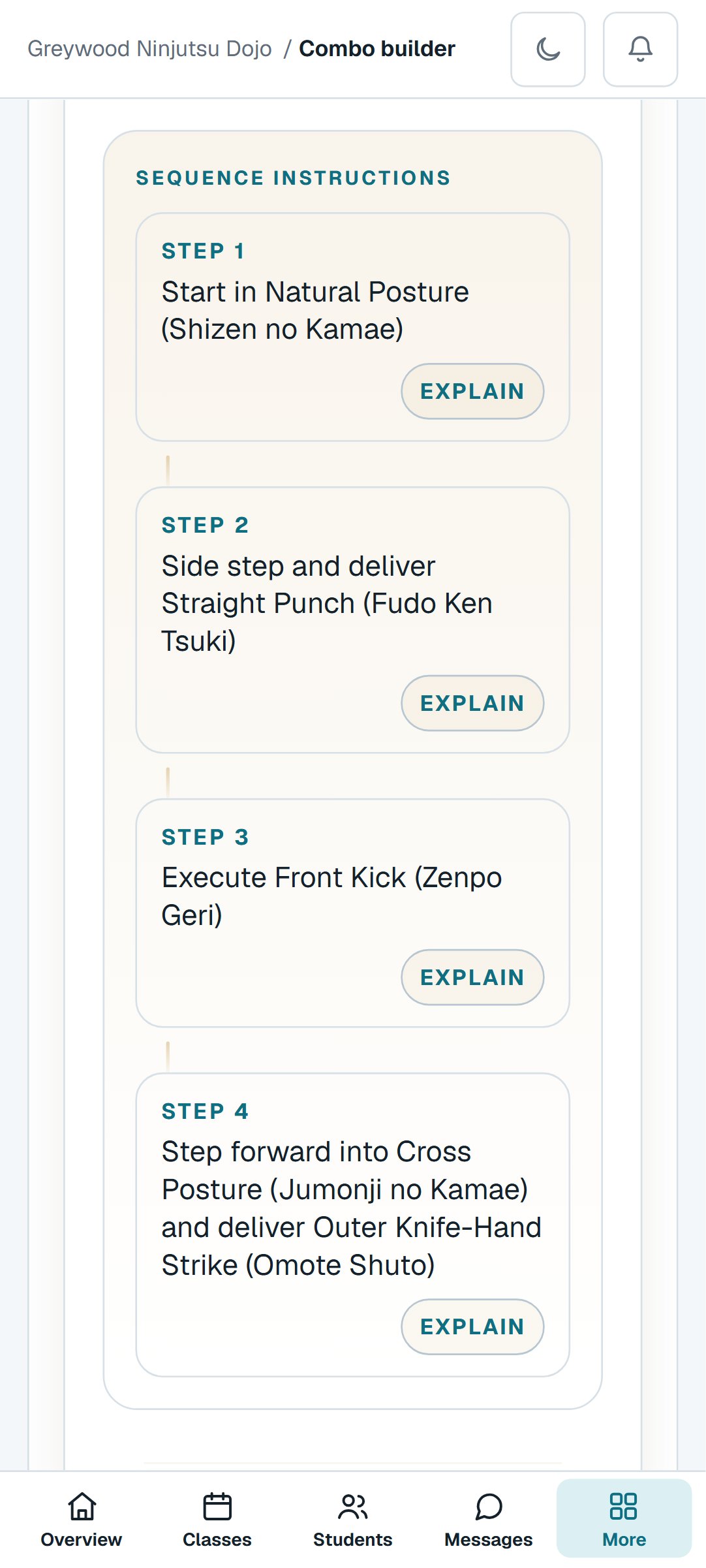
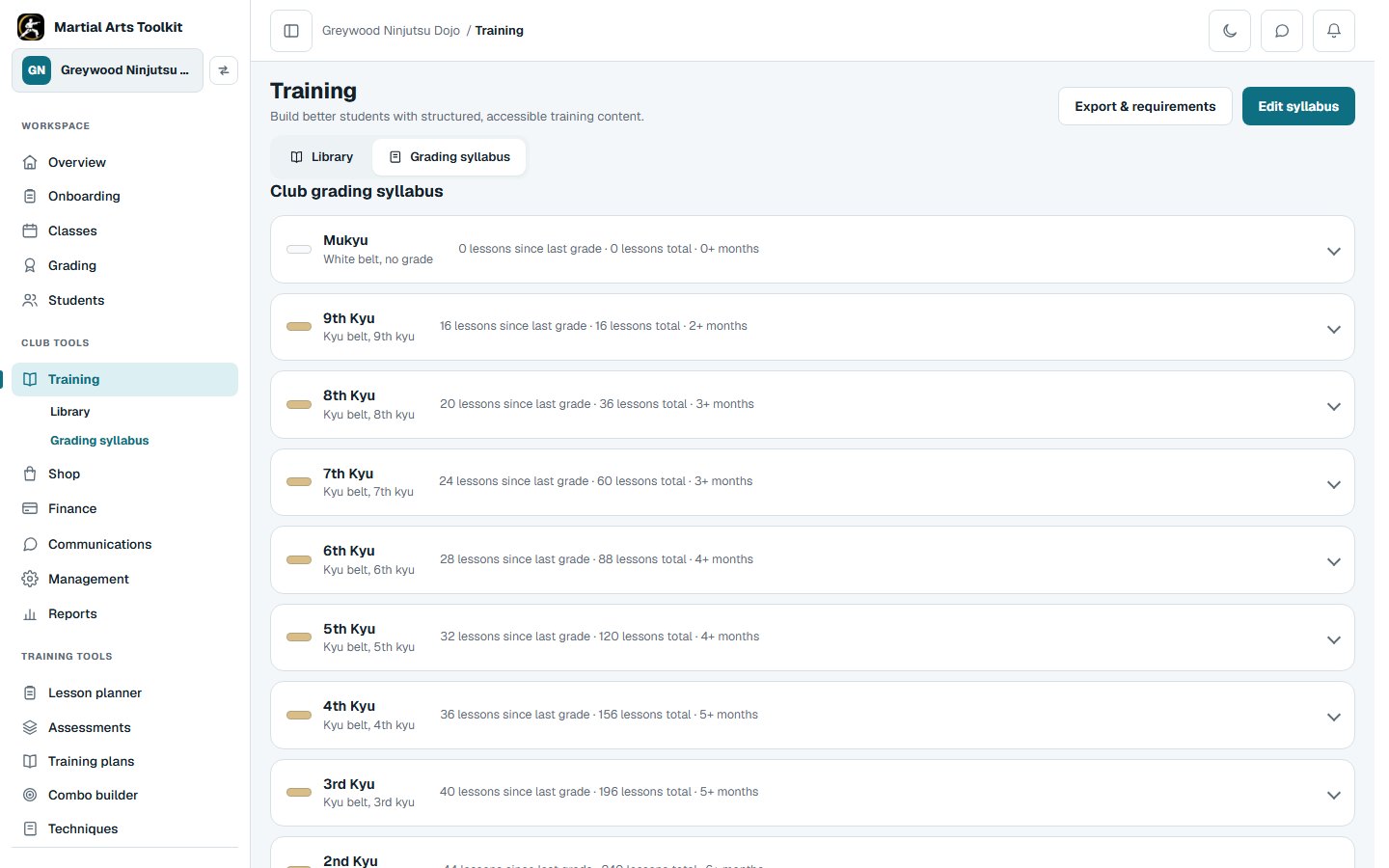
Screenshots use example data.
About the art
What is Ninjutsu?
Ninjutsu, as it is taught today, is the unarmed art (taijutsu) of the schools that trace their roots to the ninja traditions of medieval Japan. Training starts with natural postures, rolling and breakfalls (taihenjutsu), and moves on to striking weak points and to flowing locks and throws.
The core the main schools share is the Kihon Happo, eight basic techniques, and the Sanshin no Kata, five forms named after the elements. Students grade through kyu grades to black belt in organisations such as the Bujinkan, Genbukan and Jinenkan.
- Origin
- Japan
- Known for
- Rolling, evasion and flowing locks
- Technique names
- Japanese and English names
- Grades
- Mukyu to 1st Dan
How we work with Ninjutsu
Built for the way Ninjutsu is taught
The Ninjutsu technique library and a starter grading ladder are ready when you create your dojo, and you can change any of it to match your syllabus.
A taijutsu library
Postures, rolls and breakfalls, strikes, the Kihon Happo, locks, throws and grab escapes, with the teaching ideas behind them such as kuzushi and kyojitsu.
Flowing combinations
The Combo Builder links a posture, a receive, a strike and a lock the way the forms do, from the first basic form to an outer wrist lock and pin.
Kyu gradings to black belt
Start from a ladder of mukyu, nine kyu grades and shodan, and set the belt colours your school uses.
From the Ninjutsu library
- Outer Wrist Lock (Omote Gyaku)
- Warrior's Capture (Musha Dori)
- Rock Throw (Ganseki Nage)
- Outer Knife-Hand Strike (Omote Shuto)
- Forward Roll (Zenpo Kaiten)
- Heel Kick (Sokuyaku Ken)
Kata ready to use
- Ichimonji no Kata
- Hicho no Kata
- Jumonji no Kata
- Chi no Kata
- Sui no Kata
- Ka no Kata
- Fu no Kata
- Ku no Kata
Running the dojo
Everything else your dojo needs
Registers, gradings, payments and the student portal all use the same student record, so nothing has to be copied between spreadsheets.
Registers and attendance
Take the register on a phone or tablet in seconds and spot students who have stopped coming.
Grading readiness
Attendance, time in grade and assessments come together, so you can see who is ready for the next grading.
Memberships and payments
Set up memberships and take payments through Stripe, with a clear view of who has paid.
Classes and timetable
Recurring classes and one-off sessions in one timetable, with RSVP and check-in links for families.
Student and parent portal
Students and parents see grades, upcoming classes, assigned training and what to work on next.
Lesson plans and training plans
Plan classes from the technique library, assess students and give each one training to practise at home.
Try it with your own dojo
Less time on administration.
More time to teach Ninjutsu.
Create your dojo free and explore it with your own classes, or book a demo and we will show you around.
Questions
Ninjutsu dojos often ask
We are a Bujinkan dojo. Does it fit how we train?
Yes. The library is the core the Bujinkan, Genbukan and Jinenkan share. Add your school's own kata, weapons and variations as custom techniques.
Can we include weapons training?
Yes. Add the weapons your dojo teaches, such as hanbo, bo or tanto, as custom techniques, and use them in syllabuses, lesson plans and assessments.
Can we use our own syllabus and grades?
Yes. The starter ladder is only a starting point. Rename grades, change colours, add your own requirements and set the lessons and time each grade needs.
Can one club teach more than one martial art?
Yes. Choose a main martial art when you create your club and add others in the club settings. Each keeps its own technique library.
Can you move our students across from our current system?
Yes. Import students from a spreadsheet and check every row before it is saved, or send us your records and we will move them across for you free of charge.
How much does it cost?
Small clubs can use the Free plan with no card required. Paid plans add capacity and features as your club grows.